When investors want to move fast, they reach for shortcuts. Two of the most common are Gross Rent Multiplier (GRM) and NOI. Both can help you screen rental properties, but they do very different jobs.
GRM is fast because it ignores expenses. NOI is more useful because it includes them.
That tradeoff is the whole story.
Rule of thumb: use GRM to sort quickly, then use NOI to avoid fooling yourself.
What Is Gross Rent Multiplier?
Gross Rent Multiplier compares property price to gross annual rent.
Formula:
GRM = Purchase Price / Gross Annual Rent
If a property costs $240,000 and produces $24,000 in annual rent, the GRM is 10.
Lower GRM usually means a property is cheaper relative to rent. Higher GRM usually means the opposite.
What Is NOI?
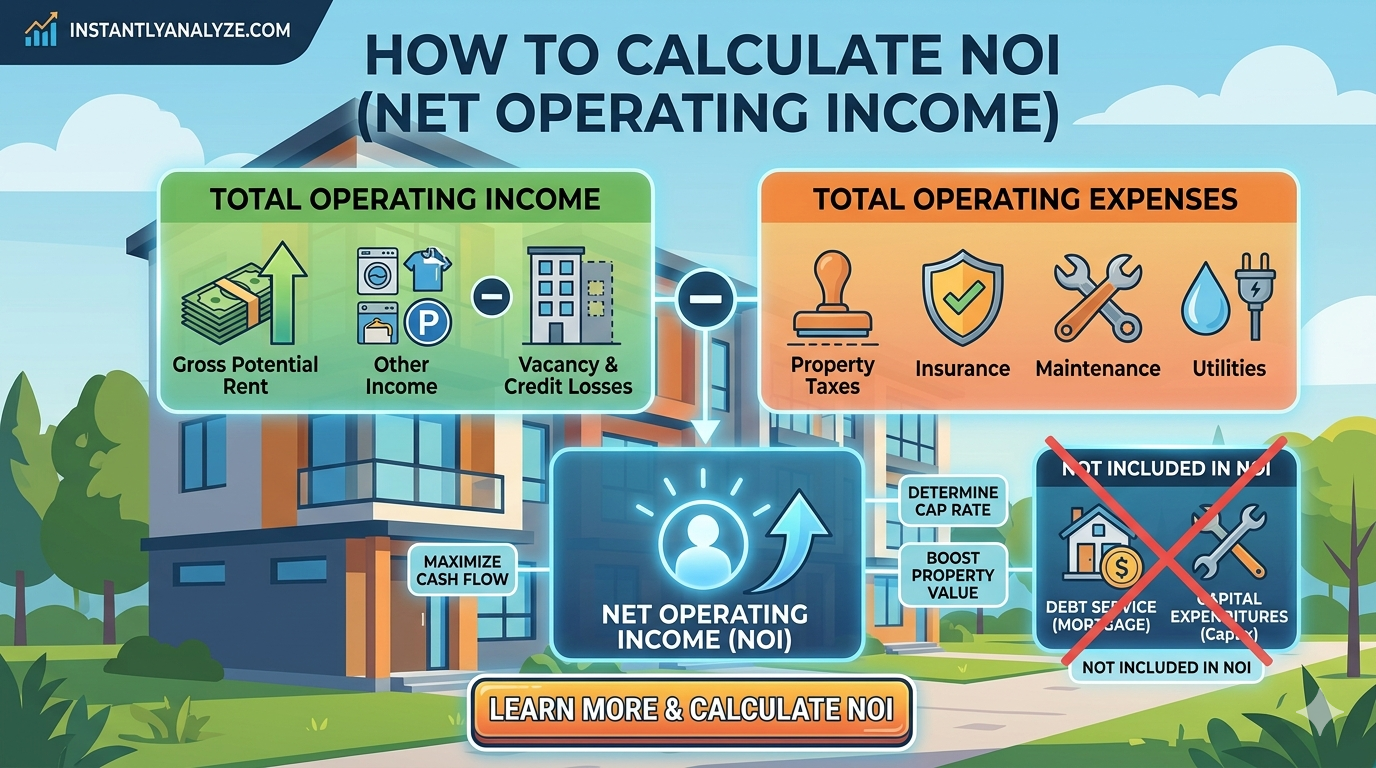
NOI measures annual income after operating expenses but before mortgage payments.
Formula:
NOI = Gross Operating Income - Operating Expenses
NOI takes more work because you need to estimate taxes, insurance, maintenance, management, vacancy, utilities, and other recurring costs. But that extra work is exactly why it is more useful.
Why GRM Is Popular
Investors like GRM because it is:
- quick to calculate from listing data
- easy to compare across a batch of properties
- useful for high-level market scanning
If you are reviewing dozens of listings in a new market, GRM can help you spot the obviously overpriced inventory first.
That makes GRM a decent top-of-funnel metric, especially when paired with a market scanner like InstantlyScan.
Why GRM Breaks Down Fast
GRM ignores operating expenses. That means two properties with the same rent and the same asking price can have the same GRM while producing very different actual returns.
Things GRM ignores:
- property taxes
- insurance
- turnover and vacancy
- deferred maintenance
- management intensity
- utilities and HOA costs
- neighborhood-level expense differences
A property with old systems, high taxes, or owner-paid utilities may look fine by GRM and still be weak by NOI.
Free to use. No credit card needed. See cash flow, cap rate, and ROI in minutes.
Start Analyzing — FreeWhy NOI Matters More
NOI gives you a much cleaner picture of the property's operating quality.
It helps answer:
- Is the rent strong enough after real expenses?
- Does this property support the asking price?
- Is there value-add upside if operations improve?
Because cap rate is built from NOI, accurate NOI is also what lets you judge valuation correctly.
Example: Same GRM, Different NOI
Suppose two properties both list for $300,000 and both generate $30,000 in annual gross rent.
| Property | Price | Annual Rent | GRM | Annual Expenses | NOI |
|---|---|---|---|---|---|
| Property A | $300,000 | $30,000 | 10.0 | $12,000 | $18,000 |
| Property B | $300,000 | $30,000 | 10.0 | $17,000 | $13,000 |
GRM says they are equal. NOI says they are not even close.
Once you convert those NOI figures into cap rate:
- Property A cap rate = 6.0%
- Property B cap rate = 4.3%
That is a major difference in price quality, and GRM alone would miss it entirely.
Best Use of GRM
GRM is still useful when:
- you are scanning many listings quickly
- you are comparing neighborhoods at a very high level
- you do not have reliable expense detail yet
Just do not confuse a quick filter with an underwriting decision.
The better workflow is:
- Use GRM to eliminate obvious mismatches
- Use the 50% rule as a rough expense sanity check
- Build a more realistic NOI
- Convert NOI into cap rate
- Run full financing assumptions to see true cash flow
Best Use of NOI
NOI matters more when:
- you are making an offer
- you are comparing two realistic finalists
- you are negotiating on price
- you are evaluating value-add execution
- you are talking with lenders or partners
At that stage, GRM is too blunt. It is directionally helpful, but not decision-grade.
Which Metric Should You Use?
If you are choosing only one metric for serious deal analysis, choose NOI.
If you are screening fifty listings and need a fast first pass, GRM can save time.
The real answer is to use each metric for the job it is good at:
- GRM for speed
- NOI for accuracy
That combination helps you move fast without skipping the part that actually protects your downside.
If you want to scan a batch of listings first, start with market analysis. If you already found a promising deal, move straight into a full property analysis and let NOI, cap rate, and cash flow line up in one place.
GRM is a shortcut. NOI is underwriting. Use the shortcut to sort, then use underwriting to decide.