After-repair value (ARV) is what a property will be worth once renovation work is done. It's the number BRRRR investors and flippers underwrite against — get it wrong and every downstream decision (max offer, refinance amount, exit price) is wrong with it.
This guide covers how ARV is supposed to work, why most shortcuts quietly inflate it, and the comp-derived method Rehab Coach uses instead.
The formula, and why it's harder than it looks
ARV = Price per square foot of comparable renovated properties × subject property square footage
Simple in theory. The entire difficulty is in one word: comparable. A comp has to be a real sale, close by, recently sold, similar in size and type — and, ideally, already renovated. That last condition is the problem: no public data source labels a past sale as "renovated." You're always inferring condition from price, not observing it directly.
Why some common shortcuts inflate ARV
Using active listings instead of closed sales. A listing price is an asking price — a seller's opening position, not what a buyer actually paid. Asking prices skew high, and using them as comps biases ARV upward, which is the most dangerous direction to be wrong in: it makes bad deals look good.
Using licensed cost-to-value tables. A common shortcut is ARV = as-is value + (renovation cost × some recapture percentage per line item — kitchens recapture X%, bathrooms recapture Y%, and so on). The only authoritative source for those percentages is a copyrighted industry report. Without a citable, public source, the percentages are guesses dressed up as data.
Letting an AI model estimate a number directly. A language model asked "what will this property be worth after renovation?" will answer confidently — and that confidence is not evidence. It hasn't seen a comp; it's pattern-matching a plausible-sounding number. A model-generated valuation is a fabrication with a good font, not an estimate.
Free to use. No credit card needed. See cash flow, cap rate, and ROI in minutes.
Start Analyzing — FreeThe comp-derived approach
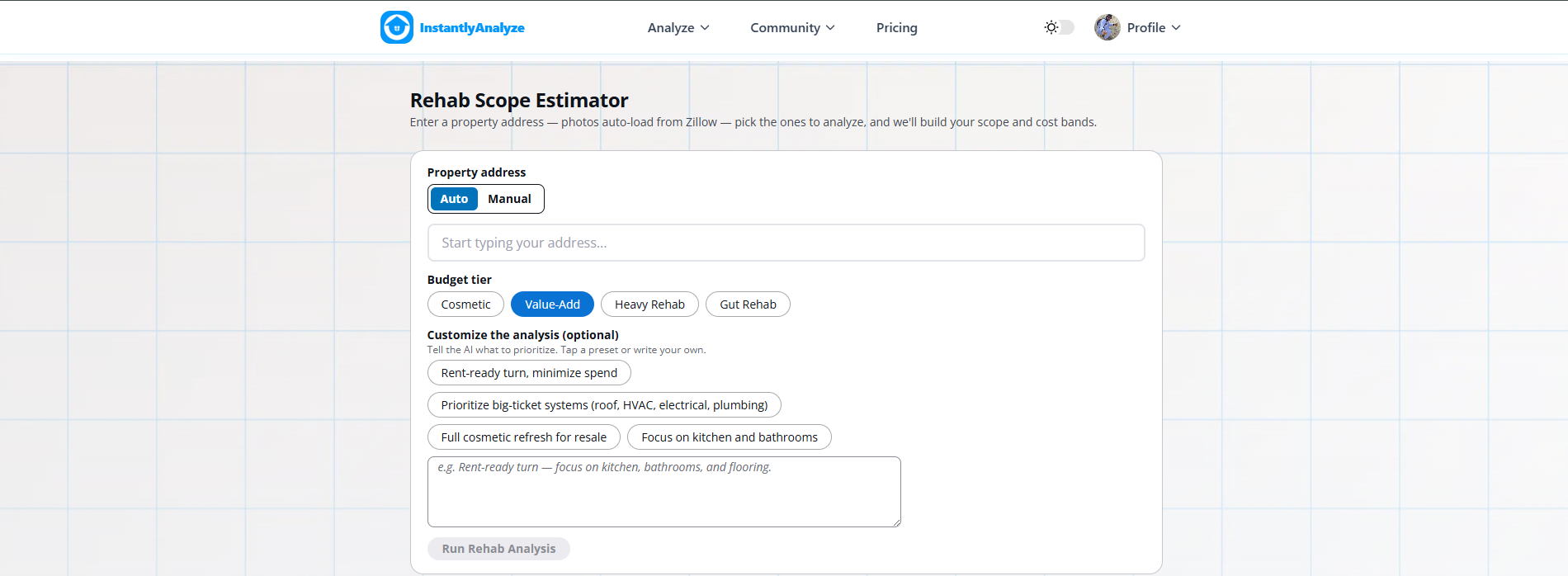
Rehab Coach's ARV estimate is built entirely from arithmetic over real comparable sale records — the model that plans your renovation scope never sees, produces, or reasons about a dollar valuation.
Filtering the comps. Every candidate comp has to clear all of these before it counts:
- Off-market only. Active listings are dropped. Only comps with a recorded off-market date are used, so the price reflects what a buyer actually paid, not what a seller was hoping for.
- Within 1 mile of the subject property.
- Sold within the last 12 months.
- Within ±25% of the subject's square footage.
- Matching property type.
- Valid price and square footage (no zero or missing values).
The 5-comp bar. If fewer than 5 comps survive that filter, no ARV number is shown — not a rough estimate, not a low-confidence range, nothing. A number built on two or three sales isn't a weaker estimate; it's a misleading one. When this happens, Rehab Coach shows the comps it did find and explains why it stopped short of a number.
The renovated-comp proxy. Even after filtering, nothing tells you which of the surviving comps were renovated before they sold. The working assumption: within a given neighborhood, the highest price-per-square-foot sales are generally the renovated ones. So instead of picking one number, Rehab Coach computes the full price-per-square-foot distribution across the qualifying comps and reads a value from the upper end of it — how far up depends on your renovation budget tier. A cosmetic refresh is underwritten to the middle of the local market; a full gut renovation is underwritten toward the top of it, since that's the finish level it's actually targeting.
Rounding. Both bounds of the resulting range round to the nearest $1,000. The underlying data doesn't support finer precision, and showing more decimal places would imply an accuracy the method doesn't have.
What you see in the product
Every ARV estimate in Rehab Coach comes with its own math shown, not just the answer:
- The ARV range itself
- Equity created (ARV minus purchase price minus renovation cost)
- The full comp table used — address, sale price, square footage, price per square foot, distance, and off-market date
- The price-per-square-foot distribution and which percentile band your budget tier selected
- An override field, if you have a better number from an appraiser or agent
If the comp bar isn't met, you get the comps that were found and a plain explanation instead of a number.
The bottom line
ARV is never a fact — every method rests on an assumption, because no data source tells you which past sales were renovated. The right response to that isn't to hide the assumption behind a confident-sounding number; it's to state the assumption plainly, show the real sales behind it, and say nothing when the data is too thin to say anything responsibly.
Want to see it on a real property? Run a Rehab Coach analysis — the ARV section computes automatically alongside your renovation scope and cost estimate.