Comparing investments with different timelines, financing structures, and cash flow patterns is one of the harder problems in real estate. An IRR calculator handles it by converting every deal into a single annualized return figure, regardless of how the cash flows are shaped.
That figure is Internal Rate of Return (IRR): the annualized return you earn on the money tied up in the investment at any given point. Unlike cap rate or simple ROI, it accounts for the time value of money across the full hold.
This guide covers what IRR is, how the formula works, what a good internal rate of return calculator actually does, and the five benefits that make it worth using on every deal.
IRR tells you: If this investment were a bank account, what annual interest rate would it pay?
What is IRR?
Internal Rate of Return is the discount rate that makes the Net Present Value (NPV) of all cash flows equal to zero. It is the annualized return you earn on your invested capital across the full life of the deal, from purchase to sale.
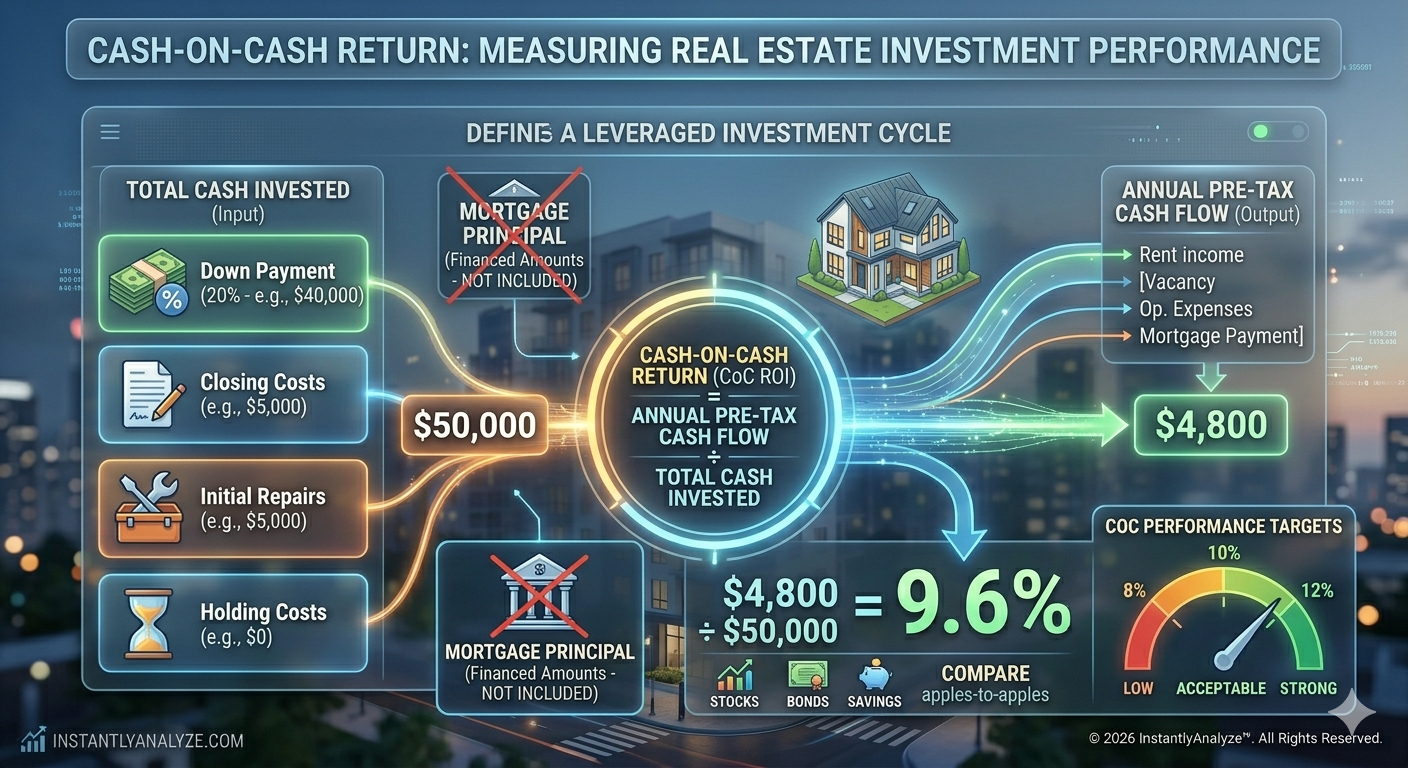
For investment comparison, it captures more than any other single metric. Cap rate measures unlevered annual income return. Cash-on-cash return measures annual cash yield on invested cash. IRR captures all of it: annual cash flows, appreciation, loan paydown, and the final sale proceeds, discounted to reflect when each dollar actually arrives.
Two properties with identical cap rates can have very different IRRs if one has higher rent growth, a shorter hold, or better exit assumptions. Cap rate won't show that. IRR will.
Why internal rate of return matters in investment analysis
Money received sooner is worth more than money received later. A dollar invested today at 7% becomes $1.07 next year. That same dollar received in Year 10 is worth about $0.51 in today's terms at the same 7% rate.
Simple ROI ignores this. It totals what you got back and divides by what you put in. IRR asks a different question: at what interest rate would you need to invest today's dollars to produce this deal's exact cash flow pattern? That rate is your actual annualized return.
For investors comparing a 3-year flip against a 10-year buy-and-hold, or evaluating a property with negative early cash flow but strong appreciation, IRR gives a fair comparison. Simple ROI does not.
Understanding the IRR formula
The IRR calculation formula, broken down
The IRR calculation formula solves the NPV equation for the rate r that makes NPV equal zero:
0 = CF₀ + CF₁/(1+r)¹ + CF₂/(1+r)² + CF₃/(1+r)³ + … + CFₙ/(1+r)ⁿ
Variables:
- CF₀ — Initial cash outflow (negative; your down payment plus closing costs)
- CF₁ through CFₙ — Net cash flows in each period (positive or negative)
- r — IRR (the rate you are solving for)
- n — Number of periods (years)
For a single-period estimate, a simpler IRR formula proxy works when cash flows arrive as a lump sum:
IRR ≈ (FV ÷ PV)^(1 ÷ n) − 1
Most rental properties have annual cash flows spread over many years, so the full NPV equation is what you actually need.
How to use the IRR formula
By hand: You guess a rate, compute NPV, adjust, and repeat until NPV reaches zero. Accurate for simple cases. Not worth it for anything with more than two or three periods.
In Excel or Google Sheets: Use =XIRR(values, dates) where values is your column of cash flows (starting with the negative initial investment) and dates is the corresponding column of dates. XIRR handles uneven timing and is the most accurate spreadsheet method.
With an IRR calculator: No spreadsheet setup required. The calculator runs the iteration and returns results in seconds.
The role of an IRR calculator
Features of an internal rate of return calculator
A good internal rate of return calculator does more than solve the math. Useful tools let you:
- Enter an initial investment and hold period
- Input year-by-year cash flows or project them using rent growth assumptions
- Include a final-year sale with net proceeds after selling costs and mortgage payoff
- Run sensitivity scenarios (change appreciation by 1% and see the IRR shift)
- Compare multiple deals side by side
One IRR number is not enough. Good tools also show how sensitive that return is to your key assumptions, because IRR is only as reliable as the inputs behind it.
Manual calculation vs. IRR calculator
| Method | Time Required | Error Risk | Scenario Testing |
|---|---|---|---|
| By hand | Hours | High | One scenario at a time |
| Excel XIRR | Minutes | Medium | Requires rebuilding |
| IRR Calculator | Seconds | Minimal | Instant what-if testing |
For investors analyzing more than a handful of deals per month, that time difference compounds. The calculator also enforces consistent methodology across every analysis, with no risk of forgotten cells or formula drift between models.
Free to use. No credit card needed. See cash flow, cap rate, and ROI in minutes.
Start Analyzing — Free5 benefits of using an IRR calculator
1. Speed
Building a clean XIRR model from scratch for each property takes real time: setting up the cash flow rows, linking appreciation assumptions, handling sale proceeds math, and keeping everything synchronized when inputs change. An IRR calculator handles all of that upfront. Enter the deal details and the return is there in seconds.
For investors working through 20 potential properties, that matters practically. Time that went into spreadsheet mechanics can go into actual judgment: Is 9.4% good enough for this market? What would need to change to get to 14%?
2. Accuracy
A transposed digit in Year 5 cash flow, a mortgage balance that did not update after changing the down payment, a sale price that did not carry through to net proceeds — any of these can move the apparent IRR by several percentage points. On a $50,000 investment decision, that kind of error is costly.
An IRR calculator removes that class of problem. The model is built once, tested once, then applied consistently. It also handles XIRR-style precision, accounting for the exact number of days between cash flows rather than rounding to annual periods. On longer holds, that precision adds up.
3. Better decisions through scenario testing
One IRR scenario is not enough to make a decision. The real use of a calculator is running ten: change the appreciation assumption from 3% to 2%, add a capex reserve, see what happens if you sell in Year 7 instead of Year 10. Each takes seconds.
This changes how deals compare. A 6-year value-add and a 12-year buy-and-hold sit on the same scale. A deal penciling at 8% IRR under optimistic assumptions sits next to a historical S&P 500 return of roughly 10% annualized, and the tradeoff becomes obvious. Working backward from a target IRR to a maximum purchase price shows exactly how much room you have to negotiate.
4. Application in real estate investments
What is IRR in real estate? It is the metric that captures what cap rate and cash-on-cash return cannot: the full picture across a multi-year hold. Cap rate is a snapshot of unlevered income at a moment in time. Cash-on-cash return is the annual cash yield on your equity. Neither accounts for appreciation, principal paydown, or the time it takes to realize those gains. IRR does.
10-year hold example:
| Year | Cash Flow |
|---|---|
| 0 | −$54,000 |
| 1 | −$1,482 |
| 2 | −$1,035 |
| 3 | −$570 |
| 4 | −$84 |
| 5 | $422 |
| 6 | $950 |
| 7 | $1,501 |
| 8 | $2,076 |
| 9 | $2,675 |
| 10 | $147,120 (operating cash flow plus $143,820 net sale proceeds) |
Deal details: $250,000 purchase price, 20% down ($50,000) plus $4,000 in closing costs equals $54,000 initial investment. $200,000 mortgage at 7% over 30 years. Rent starts at $2,200/month and grows 3% annually. Operating expenses run 45% of gross rent. The property appreciates 3% per year to $335,979 at sale; net proceeds after mortgage payoff (~$172,000) and 6% selling costs equal $143,820.
IRR: 11.2%
The early years are negative on cash flow, but appreciation and loan paydown produce 11.2% annualized. Cap rate and cash-on-cash both look mediocre on this deal in Year 1. IRR is the only metric that tells the full story.
Good IRR benchmarks for rental property:
| IRR Range | Assessment |
|---|---|
| Below 8% | Poor — stocks and REITs likely outperform with less effort |
| 8–12% | Acceptable — solid for stable, low-risk properties |
| 12–18% | Good — typical target for active investors |
| 18–25%+ | Excellent — value-add deals, BRRRR, or high-growth markets |
These benchmarks assume a 10-year hold. Shorter holds carry more risk and generally require higher IRR to compensate.
5. Comparing IRR against a real estate ROI calculator
A real estate ROI calculator measures simple return: total profit divided by total invested. Put in $54,000, net back $108,000, and your simple ROI is 100%. Easy to calculate, easy to explain — but it says nothing about when you received that money.
Two deals, both returning 2x your initial investment:
- Deal A returns 2x in 3 years (IRR: ~26%)
- Deal B returns 2x in 10 years (IRR: ~7%)
A real estate ROI calculator reports the same number for both. An IRR calculator shows Deal A is far better. The time value of the earlier return is large, and it gets larger if you reinvest Deal A's proceeds into another property before Deal B reaches its exit.
IRR does not replace simple ROI as a communication tool. "I doubled my money" is easy to explain to a partner or lender. But for the actual decision — choosing between deals, setting a target return, deciding whether to hold or sell — IRR is what tells you what your capital actually earned over time.
The Properties Analysis Tool runs both together, so you can report whichever number fits the conversation while the IRR analysis handles the real decision.
IRR vs. other metrics
| Metric | What it measures | Best for |
|---|---|---|
| Cap Rate | Unlevered income return, no financing | Comparing properties, setting valuations |
| Cash-on-Cash | Annual cash yield on cash invested | Evaluating near-term cash flow |
| IRR | Total annualized return over full hold | Comparing investments across timelines |
| Equity Multiple | Total dollars returned per dollar invested | Quick total return check |
| Simple ROI | Total profit as percent of cost | Fast baseline; no time adjustment |
IRR is the tiebreaker when the other metrics fail to separate two deals.
IRR limitations
Sensitive to exit assumptions
IRR is heavily influenced by your sale assumptions. Moving the appreciation rate from 3% to 2% on a 10-year hold can shift IRR by 3 to 4 percentage points. Run downside cases — what does IRR look like at 1.5% appreciation, or in a flat market — before trusting any projection.
The reinvestment assumption
IRR implicitly assumes all intermediate cash flows get reinvested at the same rate. In practice, that is hard to guarantee. A deal showing 18% IRR partly assumes you can redeploy every dollar of cash flow at 18%, which may not match your actual market. Modified IRR (MIRR) lets you specify a separate reinvestment rate for a more conservative estimate.
Risk is not reflected
Two deals with the same 12% IRR can have completely different risk profiles. One might be a stabilized property in a strong rental market; the other a heavy value-add in an untested neighborhood. IRR is blind to that. Always look at the assumptions behind the number, not just the number.
Conclusion
Cap rate, cash-on-cash return, and equity multiple all have their place. But for comparing investments with different hold periods and cash flow profiles, IRR gives you information that nothing else does. That said, it is only as good as the assumptions you put in — exit price especially. Stress-test those numbers before you trust the output. Run it on every deal, but run the downside cases too.
Calculate IRR for any rental property with our free analysis tool — see the complete picture in under 2 minutes.