Cash-on-Cash Return (CoC ROI) is one of the most important metrics for evaluating rental property investments. Unlike other return calculations, CoC ROI focuses specifically on the cash you put into a deal versus the cash you get back, making it an essential tool for leveraged real estate investments.
Key Insight: CoC ROI is particularly valuable for leveraged investments because it measures the return on your actual cash investment, not the total property value.
What is Cash-on-Cash Return?
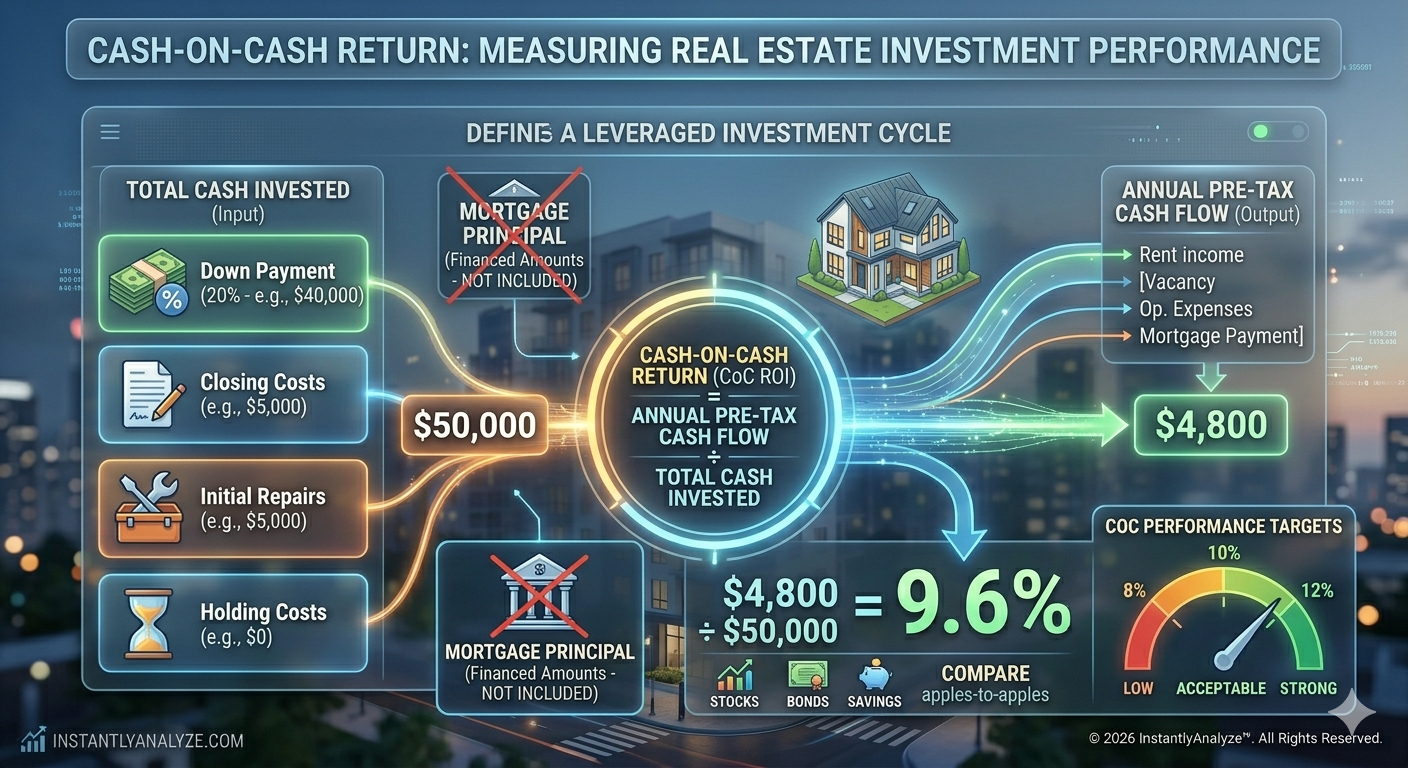
Cash-on-Cash Return measures the annual return on the actual cash invested in a property. It's calculated by dividing the annual pre-tax cash flow by the total cash invested.
Formula:
Cash-on-Cash Return = Annual Pre-Tax Cash Flow ÷ Total Cash Invested
Example:
- Property purchase price: $200,000
- Down payment (20%): $40,000
- Closing costs: $5,000
- Initial repairs: $5,000
- Total cash invested: $50,000
- Annual cash flow: $4,800
- CoC ROI: $4,800 ÷ $50,000 = 9.6%
Free to use. No credit card needed. See cash flow, cap rate, and ROI in minutes.
Start Analyzing — FreeWhy Cash-on-Cash Return Matters
Focus on Actual Cash Investment
Unlike cap rates, which consider the entire property value, CoC ROI focuses on your actual out-of-pocket investment. This makes it particularly valuable for leveraged investments where you're using financing.
Comparison Tool
CoC ROI allows you to compare real estate investments with other investment opportunities like stocks, bonds, or savings accounts on an apples-to-apples basis.
Performance Tracking
You can track how well your cash is performing over time and make decisions about refinancing, selling, or acquiring additional properties.
What's Included in Cash Invested
Initial Cash Outlay
- Down Payment: The percentage of purchase price paid upfront
- Closing Costs: Title insurance, attorney fees, inspections, etc.
- Initial Repairs: Immediate fix-up costs before renting
- Holding Costs: Utilities, insurance, taxes during renovation period
Not Included
- Financed Amounts: The mortgage principal is not your cash investment
- Future Capital Expenditures: Major repairs done later with cash flow
- Ongoing Operating Expenses: These are already factored into cash flow
Ready to calculate cash-on-cash returns for your potential investments? Try our comprehensive Properties Analysis Tool to see detailed CoC ROI calculations along with other crucial investment metrics.
Looking to master more real estate investment metrics? Check out our guides on cap rates, the 1% rule, and the 50% rule to build a complete analytical toolkit.