Real estate investing gets expensive when you trust a good story more than the numbers. A listing can look profitable at first glance, but rent, taxes, debt service, repairs, vacancy, and reserves all need to work together before a rental deserves your capital.
That is where real estate investment software earns its keep. Instead of rebuilding the same spreadsheet for every property, InstantlyAnalyze helps rental investors move from "I found a property" to "buy, pass, or renegotiate" with a cleaner underwriting workflow.
Summary
InstantlyAnalyze helps investors replace guesswork with data-driven rental analysis. Start with core inputs like purchase price, expected rent, property taxes, and financing, then review metrics such as cash flow, cash-on-cash return, cap rate, return on equity, and debt coverage. This guide explains where those metrics fit, why rough spreadsheet math misses hidden costs, and how software can make rental property decisions faster and more consistent.

Why Real Estate Investor Tools Matter
The simplest rental question is whether rent covers the mortgage. The better question is whether rent covers the mortgage, operating expenses, future repairs, vacancy, management, and still leaves enough return to justify the risk.
InstantlyAnalyze is built for that second question. The rental property analyzer turns your deal inputs into a complete underwriting view so you can compare properties with the same framework every time. That matters when you are screening multiple listings, sharing a report with a partner, or deciding whether an offer price needs to come down.
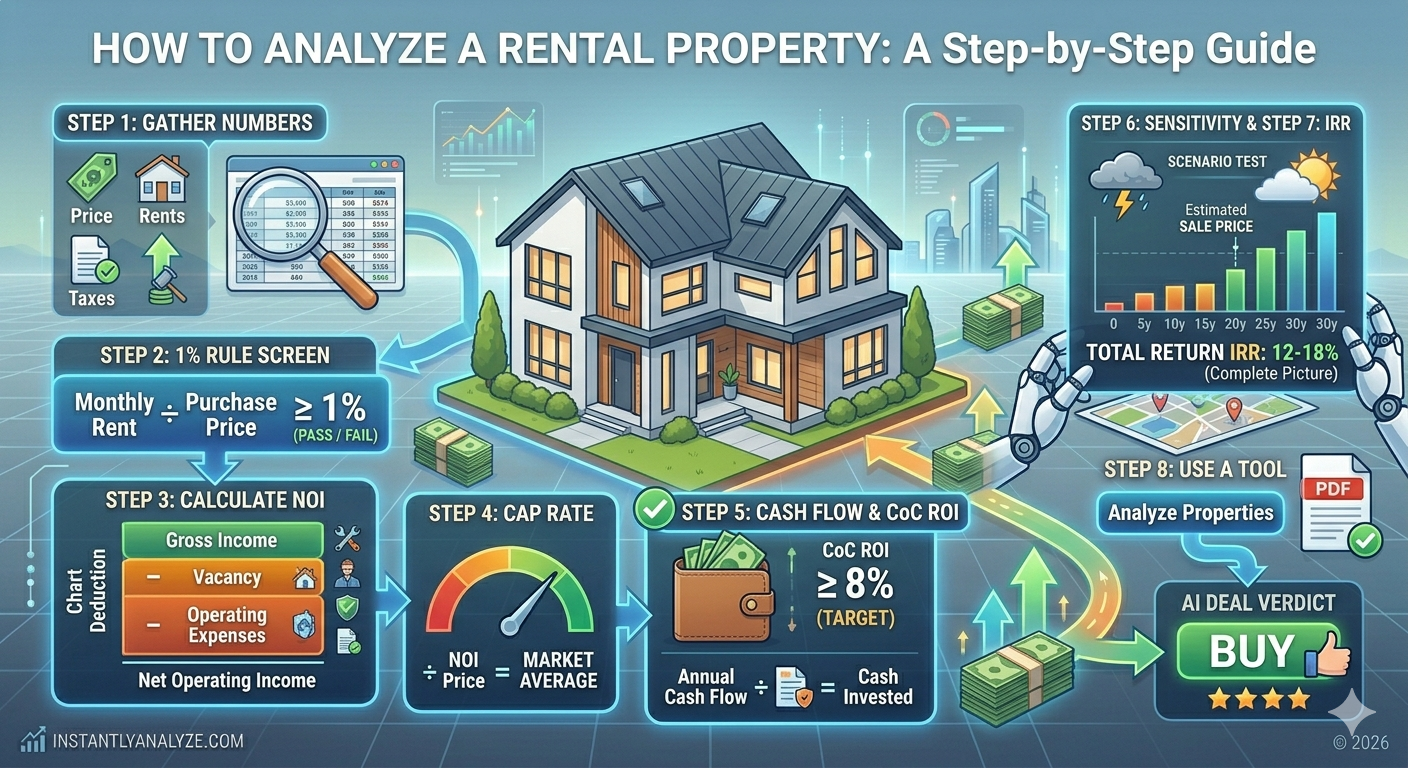
If you are new to the process, start with a full walkthrough on how to analyze a rental property. Then use software to make that process repeatable.
Beyond the Mortgage: Cash-on-Cash Return
Your down payment, closing costs, and rehab budget are real cash leaving your account. Cash-on-cash return tells you how efficiently that cash is working.
The formula is straightforward:
Cash-on-Cash Return = Annual Pre-Tax Cash Flow / Total Cash Invested
To calculate it:
- Estimate annual cash flow after operating expenses and debt service.
- Divide that annual cash flow by the total cash invested.
- Multiply by 100 to convert it into a percentage.
Many buy-and-hold investors look for cash-on-cash returns around 8% to 12%, but the right target depends on market, risk, leverage, and your investment goals. A low-cash-flow appreciation market and a high-cash-flow Midwest market should not be judged with the same expectations.
The important habit is consistency. If you calculate cash-on-cash return differently for each deal, you are not comparing investments. You are comparing assumptions.
Use the 50% Rule to Estimate Hidden Costs
Gross rent minus mortgage payment is not profit. Operating expenses come first.
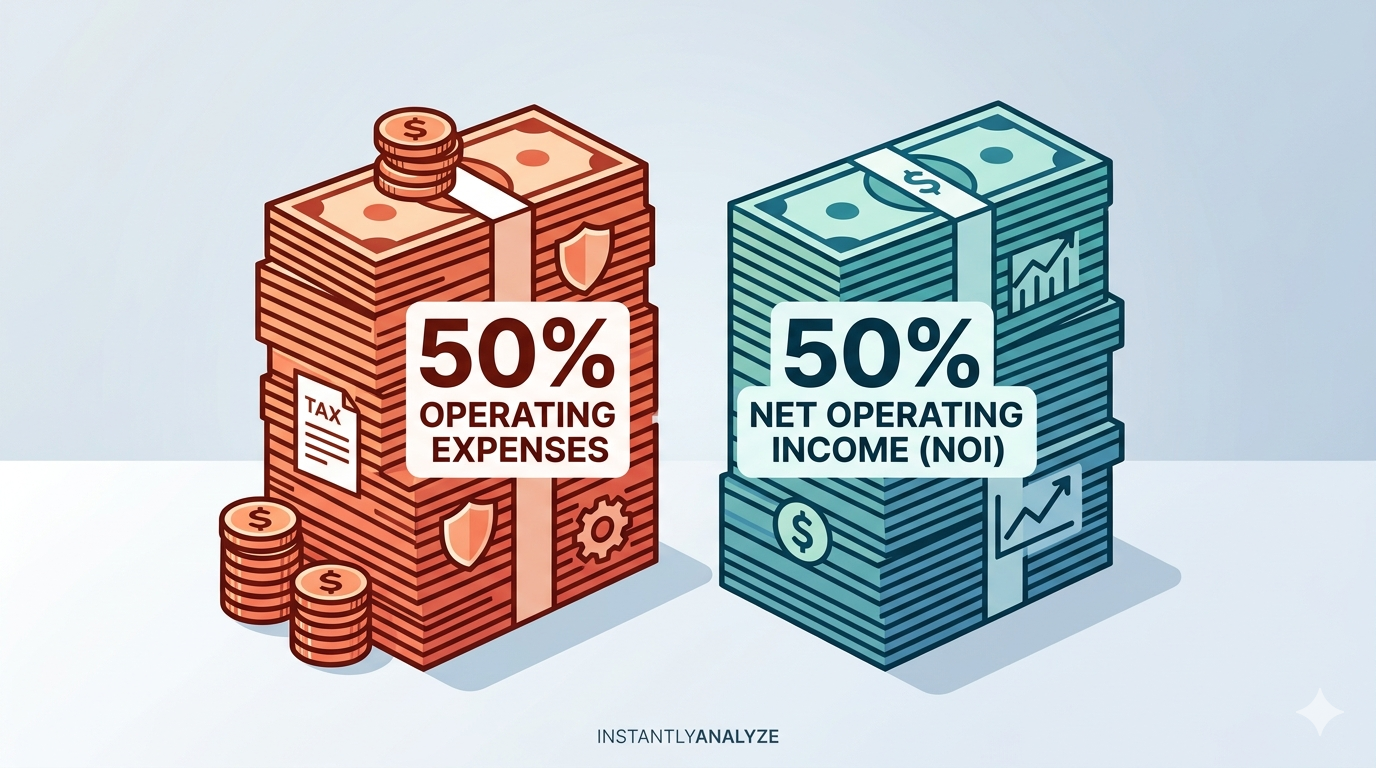
The 50% rule is a quick screening shortcut that assumes roughly half of gross rent will go toward operating expenses before debt service. If a property rents for $1,500 per month, the rule estimates about $750 for operating expenses and $750 left for mortgage payments and cash flow.
Those expenses usually fall into three buckets:
- Fixed costs: Property taxes, insurance, HOA fees, and other predictable bills.
- Variable costs: Repairs, maintenance, vacancy, utilities paid by the owner, and property management.
- Future reserves: Larger capital expenses like roofs, HVAC systems, appliances, and exterior work.
For a deeper view, calculate net operating income directly:
NOI = Gross Rental Income - Vacancy - Operating Expenses
NOI is the foundation for cap rate, lender coverage ratios, and long-term rental performance. A tool like InstantlyAnalyze helps you move from a quick rule of thumb to a more complete expense model without losing speed.
Free to use. No credit card needed. See cash flow, cap rate, and ROI in minutes.
Start Analyzing — FreeCap Rate, ROI, and Return on Equity
No single metric tells the whole story. Good rental underwriting uses several metrics because each one answers a different question.
| Metric | Formula | What it tells you |
|---|---|---|
| Cap rate | NOI / purchase price | How the property performs before financing |
| Cash-on-cash return | Annual cash flow / cash invested | How hard your out-of-pocket cash is working |
| Rental property ROI | Return / investment | Broad return, depending on what you include |
| Return on equity | Annual cash flow / current equity | Whether your trapped equity is still productive |
Cap rate is useful for comparing properties across markets because it ignores your personal loan terms. Cash-on-cash return is useful because it includes your leverage and cash invested. Return on equity becomes more important later, after appreciation and loan paydown create more equity in the property.
InstantlyAnalyze keeps these numbers in one place so you can look at the same deal from multiple angles instead of relying on one headline metric.
Why Manual Spreadsheets Fall Short
Spreadsheets can work, especially for investors who enjoy building their own models. The problem is that homemade underwriting often breaks in predictable ways:
- Formulas get copied incorrectly.
- Tax, insurance, and maintenance assumptions go stale.
- Rent estimates are not checked against comps.
- Sensitivity scenarios are skipped because they take extra time.
- It becomes hard to compare ten deals quickly.
Many beginners also miss tax depreciation, principal paydown, reserves, and exit assumptions when they focus only on monthly cash flow.
Real estate deal analysis software does not remove judgment from the process. It gives your judgment a better operating system. Zillow and broad estimate tools can help you understand a listing. Rent data tools can help validate market rent. InstantlyAnalyze is the layer where those assumptions become a full investment model.
Forecast Returns with Scenario Analysis
Interest rates, insurance costs, property taxes, rent growth, and appreciation can all change after you buy. A deal that barely works today may fail when one input moves against you.
Run "what if" scenarios before making an offer:
- What if rent is 5% lower than expected?
- What if the property sits vacant for two months?
- What if insurance or taxes rise faster than expected?
- What if the roof needs replacement in year two?
- What if you refinance at a different interest rate?
This is where software beats static spreadsheet math. InstantlyAnalyze helps you pressure-test the deal before your money is committed, then explain the result in a format you can share with partners, lenders, or your future self.
Your Action Plan for the Next Rental
Use this simple workflow when you find a listing worth screening:
- Gather the basics: purchase price, expected rent, property taxes, insurance, financing terms, and known repairs.
- Validate rent with local comps or the rent estimator.
- Enter the deal into the rental property analysis tool.
- Review cash flow, NOI, cap rate, cash-on-cash return, and debt coverage.
- Run a downside scenario before deciding whether to buy, pass, or renegotiate.
The goal is not to make every deal look good. The goal is to spot weak deals quickly and spend your time on properties that deserve deeper attention.
Q&A
What information do I need to analyze a rental in InstantlyAnalyze?
Start with purchase price, expected rent, property taxes, insurance, financing terms, and any known repairs. You can add more detail as you learn more about the property, but those inputs are enough for a first-pass rental analysis.
How do I calculate cash-on-cash return?
Divide annual pre-tax cash flow by total cash invested, then multiply by 100. Total cash invested usually includes down payment, closing costs, and initial rehab. Use the same definition across every deal so your comparisons stay honest.
What is the 50% rule in real estate?
The 50% rule estimates that roughly half of gross rent will go toward operating expenses before the mortgage. It is useful for quick screening, but it should be replaced with real tax, insurance, vacancy, maintenance, management, and reserve assumptions before you make an offer.
How are cap rate, cash-on-cash return, and return on equity different?
Cap rate measures property-level return before financing. Cash-on-cash return measures annual cash flow against your actual cash invested. Return on equity measures whether the equity you have built in the property is still producing enough cash flow.
Why use real estate investment software instead of a spreadsheet?
Software makes the analysis faster, more consistent, and easier to compare across properties. A spreadsheet can work, but InstantlyAnalyze reduces formula risk, keeps key metrics together, and helps you turn assumptions into a shareable rental investment report.
Ready to screen your next deal? Try the free rental property analysis tool and review cash flow, cap rate, ROI, and an AI deal verdict in minutes.